‹ BackNewsworld models

world models

AMD to Acquire Fei-Fei Li’s World Labs in $8.2 Billion All-Stock Deal
Lisa Su says AMD welcomes World Labs and Fei-Fei Li
Aether AI
2026-09-20 08:39:21

Aether AI unveils CausalWM, a 16B causal world model that tops TriWorldBench

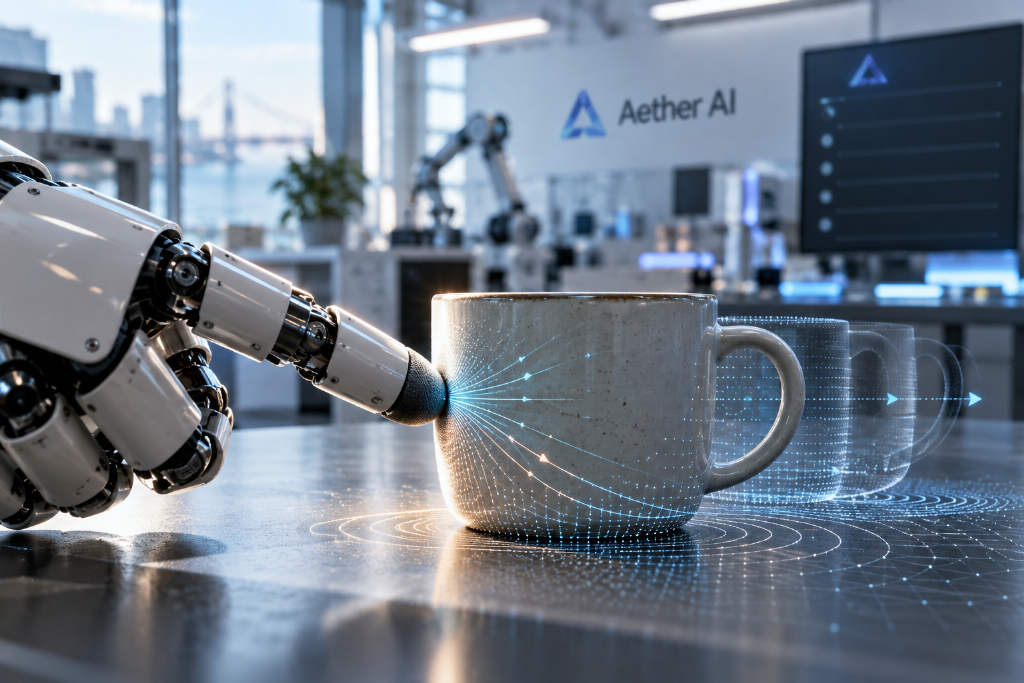
Aether AI has released the first version of its causal world model, CausalWM, a 16B-parameter system built around what the team calls Causal Chain-of-Thought. Instead of jumping straight from a current frame to a future frame, the model explicitly predicts intermediate physical variables such as optical flow, depth, and pointmaps, then feeds those results back into the context before generating future observations. The goal is not only to predict what the future looks like, but to model how that future unfolds step by step. According to the article, CausalWM ranked No. 1 on the latest TriWorldBench leaderboard with a TWB-Score of 66.04, a benchmark focused on robotic world-model prediction and consistency across head, left-wrist, and right-wrist camera views. The team also reported leading results on PAI-Bench and other embodied world-model benchmarks. Aether AI said the method uses a stage-ordered attention mask to keep the reasoning chain causal during both training and inference, and trains the model in three stages: pixel-level pre-training, Causal CoT mid-training, and multi-objective RL post-training. The release includes a paper, code, model weights, and a project page. The article frames CausalWM as Aether AI’s first step toward what it calls real-world causal intelligence, extending the team’s earlier RSIAgent work from software environments into the physical world.

400
Aether AI unveils CausalWM, a 16B causal world model that tops TriWorldBench
PhAI Labs
2026-09-20 00:21:10

JEPA-Anything tests one predictive framework on liver cancer models and planetary orbits

PhAI Labs and researchers from Oxford, Stanford, Princeton, and the Chinese University of Hong Kong have introduced JEPA-Anything, a cross-domain framework built to learn predictive models across very different kinds of systems. The paper asks whether AI can share a deeper learning principle when modeling how things change, even when the underlying mechanisms range from cells and patients to weather systems and planetary motion. The architecture keeps each domain’s own observation format, encoder, and context-target setup, but shares a common predictive core and a unified latent world-state interface. Its key mechanism, Orthogonal Predictive Factorization, splits target states into complementary subspaces handled by separate predictive branches, with orthogonality and activity constraints meant to reduce redundancy and collapse. The framework was evaluated across seven classes of systems: vision, biology, clinical data, control, molecules, physical fields, and weather. In a controlled intervention benchmark, it reduced prediction error by about 11.7% on in-distribution single interventions and cut MSE by about 3.5% on unseen multi-factor combinations. In a matched benchmark of 10 tasks, it improved results in 9, including MSE reductions of 39.7% on the Burgers equation, 39.3% on shallow water equations, and 10.5% on WeatherBench 2. The paper also highlights two analysis cases. In liver cancer experiments, internal factors led researchers to a candidate intervention, IL-18 plus NT5E/CD73 blockade, later tested in co-culture, organoids, tumor fragments, and immunocompetent mice. In simulated orbital data, latent modes recovered a frequency-semi-major-axis scaling slope of -1.4991, very close to the -1.5 value implied by Kepler’s third law, with R²=0.99999999.


340
JEPA-Anything tests one predictive framework on liver cancer models and planetary orbits
World Models
2026-09-11 02:56:12

What counts as a world model? Fei-Fei Li, LeCun and Zhu Jun offer three different answers

The term "world model" has become one of the least settled concepts in AI in 2026. It can refer to a model that generates coherent video, a digital environment that keeps responding to user input, a latent-space system that predicts future states, or a policy that outputs robot actions. Those systems all process information about the world, yet they do not solve the same problem, and comparing them by visual quality, geometric consistency, prediction accuracy or task success can blur more than it clarifies. A MarsBit article, citing work from World Labs, Meta and Tsinghua University professor Zhu Jun’s team, lays out three leading interpretations. Fei-Fei Li and World Labs sort world models into renderers, simulators and planners. Yann LeCun argues for learning predictable structure in an abstract latent space. Zhu Jun and his collaborators define a broader "general world model" from first principles, built around three linked capabilities: understanding, imagination and action. Their framework also proposes a five-level roadmap from L1 world generation to L5 world organization, and places video generation, real-time interaction and embodied control on a single capability curve. The piece further examines a data pyramid spanning internet video to robot interaction, the MoT architecture for multimodal coordination, and Motus2, which combines policy generation, simulation, evaluation and tactile feedback in one closed-loop system.

800
What counts as a world model? Fei-Fei Li, LeCun and Zhu Jun offer three different answers
Runway says ARR hit $200 million after doubling in five months
Runway acquires Paris-based AI research firm Kinetix for robotics world model work
Former DeepMind Researcher Launches Adaptive AI Agent Startup